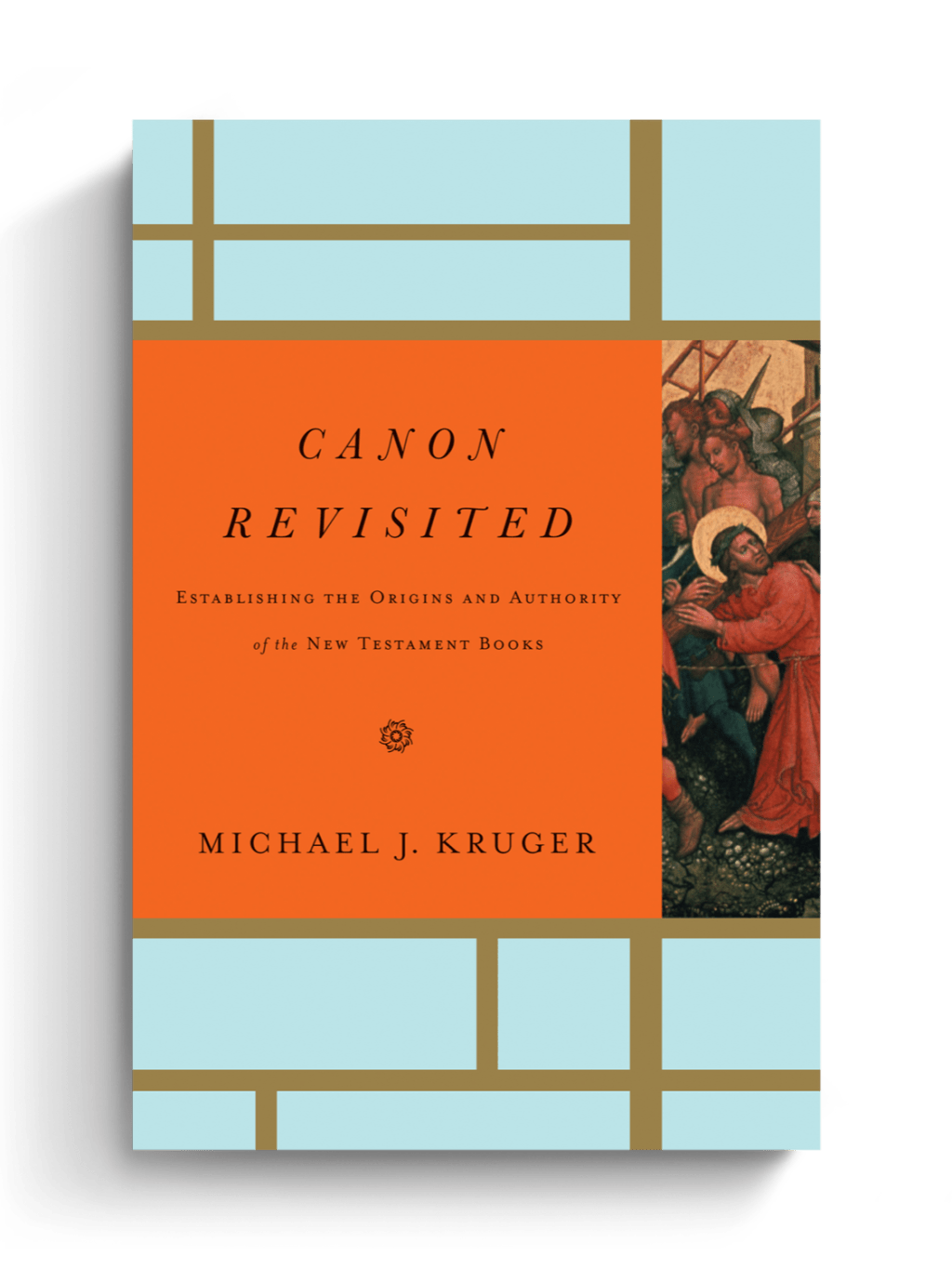
In September 2023, a fellow student recommended to me Michael Kruger’s book, Canon Revisited.1 This was in response to my persuasion that the Bible evinces something like “inspired textual updating.”2 In this friend’s perspective, textual updating would violate the intrinsic canonical status of any text that was divinely inspired, something Kruger calls “ontological canonicity.” Of course, this piqued my interest. Although I knew Kruger focused on the New Testament side, I had already wanted to read him on canon generally. So after this friendly challenge, I made the time. The whole book was excellent, good for any pastor, informed churchman, or skeptic. Below, however, are simply my thoughts on how Kruger’s paradigm for understanding the canon and canonicity can shed light on the doctrinal question of textual updating. This review, therefore, does not cover all parts of the book equally (though I read and recommend the whole), but focuses on its first half.
The bottom line: I expected to align with Kruger in methodology and theology, and I have found that to be true. I do not think that his category of “ontological canon” excludes the potential for inspired textual updating when the latter is understood on its own terms.
I can easily affirm Kruger’s three-tiered definition of the NT canon and its corresponding dates in church history: the ontological canon (instantaneous, first century), the functional canon (at least by the second century), and the exclusive [i.e., confessional] canon (third-fourth century). These same categories suit the OT canon also, at least conceptually. But the stages of their succession must be applied book-by-book rather than as a corpus (except for the Pentateuch) and over a much longer window of time—a millennium—since the OT books were written in disparate seasons. Likewise, the third type/stage of “canonization” (the exclusive or confessional), would usually have occurred simultaneously with the second (functional), because of the mechanisms and institutions ordained in OT Israel for the custody and transmission of Scripture. Importantly, Kruger asserts that while any book that is canonical in the first degree will eventually possess the status of the second and third degrees, it can nevertheless be referred to as “canonical” before then (e.g., the Gospel of John was canonical “while the ink was still wet”). Granted, the paradigm for this assertion of Kruger’s is explicitly the NT, but the point needs further nuancing if applied to “canon” more generally, as in the doctrine of “Scripture” established by key NT texts (Luke 24:27, 44; Rom 16:25–26; 1 Tim 5:18; 2 Tim 3:15–16; 2 Pet 1:21; 3:2, 16).
I also affirm Kruger’s “self-authenticating” model of canon, as opposed to the community-determined and historically-determined models, and this, not only for the NT but also for the OT. His introduction and first three chapters were quite helpful. He obviously has an appropriate interest in apologetics and epistemology, which are helpful for the argument. The key to his model is that Scripture guides the process of investigation; i.e., it defines what external and internal data are to be used in the recognition of the canon.
Kruger’s main argument (or more accurately, his presupposition) is that God has provided the proper epistemic environment to recognize the canon, which environment may be described in three components: providential exposure, attributes of canonicity, and the internal testimony of the Holy Spirit. His attributes (as opposed to criteria) of canonicity are then divided into three as well: divine qualities, corporate reception, and apostolicity. The two substrata, however, do not map onto the OT process precisely. For example, the environment in which the writings of the prophets were canonized differed from the NT by having these three factors: (i) a divinely authenticating testimony, usually through a secondary, subsequent prophet, (ii) a God-ordained custodial institution, the priesthood, and (iii) a God-ordained repository, the tabernacle/temple, all for the recognition, collection, preservation, and reproduction of canonical books. Of course, as the Torah was being given, subsequent authentication by a prophet was not needed, because of God’s continual authentication to all of Israel at once regarding Moses and the texts delivered through Him. As well, when the temple was destroyed in 586 BC, the other two factors of prophetic authentication and priestly custody were sufficient for the recognition and preservation of Scripture—as evidenced at least by the ministries of Daniel, Ezra, and Nehemiah—until the latter restored a repository to the post-exilic temple. In post-biblical times, the repository was maintained still (e.g., 2 Macc 2:13–14).
An important caveat to this summary of the OT process is that the acceptance of a prophet’s works was not always immediate, nor even was (were) the author(s) always known to subsequent generations in Israel. Hence, the importance of subsequent authenticating prophets seems to replace the “apostolicity” attribute of NT canonization and the central repository would replace the “corporate reception” attribute. There were no disbursed congregations of Israel but a centralized religious administration.
Some other helpful points I picked up from Kruger’s arguments and notes are the following. First, while the distinction between Scripture and canon is usually untenable, it is useful in one respect: the apostolic writings that are no longer extant, like the letters alluded to by Paul that he had written to the Laodiceans (Col 4:16), the Philippians (Phil 3:1), or (twice) the Corinthians (“A” and “C”)—all being now lost to history (1 Cor 5:9; 2 Cor 2:3–4; 7:8). Kruger affirms that these were “inspired by the Holy Spirit” (p. 95)—and I would venture to say that he even implies they were intended by God to function as canon to the churches who received them (and even to other churches! [Col 4:16])—but not sovereignly preserved as a foundation for the church (“providential exposure”; cf. Eph 2:20).
Second, related to the above, I found helpful Kruger’s reference to Abraham Kuyper’s language (p. 96n22) that there was a “predestined Bible” or “preconceived form of Holy Scripture”3 standing behind the phenomenon that some books were either forgotten or lost while others were not. I have not read this in Kuyper but wholeheartedly agree with this approach as subsidized by Kruger. I would envision this factor, shall we call it the “predestined canon,” as standing behind the final form not only of the “table of contents” but of the contents themselves, i.e., the books, their length, their internal order/arrangement, and every feature of their text down to the “jot and tittle” (cf. Matt 5:18).
On that note, it is critical to formulate a doctrine of the canon in light of the fact that in God’s providence, every generation of His people without exception has had a different level of exposure than the generation before it to the extant manuscript evidence for the autographs of the ontological canon. This fact is predicated on the facts that (a) every generation of God’s people since Sinai has been charged with the responsible copying and using of Scripture and (b) many generations of His people lived at moments when new inspired texts were being given. Thus, while God’s inspired Word is always authoritative and binding, whether or not men recognize or preserve it, His sovereignty has appointed a particular remnant or corpus of that Word for the accomplishment of His purposes in each generation. During the compositional period of the OT, this included the ability of authenticated prophets to update and expand—even to correct, if they were so led, wherever transmissional errors might have existed—the canonical text at their disposal in their times. Moreover, the non-prophetic but priestly custodial mechanisms in place held the responsibility of preserving the canonical text, which must include some degree of linguistic accommodation. Heretofore the latter notion is not widely envisioned by conservative views of Scripture’s verbal, plenary inspiration, but, in my judgment, it does not challenge the doctrine whatsoever. All this means that for the Church, “having been built on the foundation of the apostles and prophets, Christ Jesus Himself being the corner stone” (Eph 2:20; cf. Matt 16:18; Jude 3) and the book of Revelation being the canonical capstone, at least, until the return of Christ (Rev 22:18–20; cf. Heb 1:1–2; 2:3–4), the “predestined Bible” reached its final ontological stage of canon in the first century AD.
Yet, at that stage, a pristine text—either for the already recognized OT corpus or for the increasingly recognized books of the NT—did not exist. Precisely discovering the bounds of the critical text of the ontological canon, guided by the Holy Spirit, is the church’s ongoing prerogative, and this too is within God’s “preconceived form of Holy Scripture” at present. The perfectly preserved pristine text of the canon’s autographa (much less their manuscripts) is not an artifact God has given to His people for His own good reasons. I perceive that one of those reasons (and simultaneously one of His preservative solutions) may be the mechanism of inspired textual updating in the OT corpus.
Third, the working out of this self-authenticating model (especially as it regards the testimonium) Kruger cogently specified does not assume the prerogative or ability to perform textual criticism on variant readings. For him, the divine qualities of Scripture “are bound up with the broader meaning, teaching, and doctrine communicated by a book” (101n37). However, it seems to me that the testimonium, coming, as he defines it, ordinarily through evidence and deduction, granting believers the ability to recognize “the divine qualities of Scripture that are objectively there” (ibid.) could be analogous to some exercise of textual criticism in addition to canonical criticism. That is to say, the testimonium could guide believers to recognize anomalies within the received text (e.g., Mark’s Gospel affirmed, but its long ending with many unique terms and doctrines doubted). In this same discussion, Kruger estimates, “As a result, two different copies of the book of Galatians, though they would differ at minor points, would both still communicate divine qualities” (ibid., emphasis his). Kruger does not specify what “minor” means—whether he has in mind scribal variants descended from a common autograph, or on the other hand literary variants descending from the same author or another author. But this question becomes more significant when applied to the Old Testament, since, unlike the New Testament, different versions of OT books did at times exist in use, possibly even in distribution and circulation, before they were completed in the form now attested by the MT (e.g., the individual books of the Pentateuch; Samuel; Kings; Proverbs; Jeremiah).4 I would affirm that such earlier editions, though now lost, were “canonical” (a) in the sense of possessing the divine qualities of inspiration and authority for the people of God, (b) in the sense of their function among the people of God who received them, but not (c) in the sense of their being “predestined” as final and foundational for subsequent generations to receive.
Fourth, Kruger correlates his three types or definitions of canon to the theory of three types of speech-acts. These are, respectively: locution (the act of writing [i.e., the autographs]), illocution (the function of the writing [approximately, lection]), and perlocution (the effect of the writing [approximately, confession]). I do find the correspondence helpful for the first two types; though, the third is quite opaque.
Finally, authors whom Kruger has frequently cited favorably, whom I also have anticipated or have read as helpful are these: Stephen B. Chapman, Paul Helm, Christopher Seitz, and Stephen G. Dempster.
Endnotes
- Michael J. Kruger, Canon Revisited: Establishing the Origins and Authority of the New Testament Books (Wheaton, IL: Crossway, 2012). ↩︎
- Michael A. Grisanti, “Inspiration, Inerrancy, and the OT Canon: The Place of Textual Updating in an Inerrant View of Scripture,” JETS 44, no. 4 (December 2001): 577–98; “The Composition of the Old Testament,” in The World and the Word: An Introduction to the Old Testament, Eugene H. Merrill, Mark Rooker, and Michael A. Grisanti (Nashville: B&H, 2011), 79–92. ↩︎
- Abraham Kuyper, Encyclopedia of Sacred Theology: Its Principles (New York: Scribner, 1898), 474. ↩︎
- While Jesus “traditions” and memorized material were no doubt in circulation among the church of the first century before the Gospels were written, in my judgment (and in that of many evangelicals) no solid evidence has yet been adduced to support the existence of prior Greek editions, in whole or in part, of those Gospels. The only analogy to the OT books listed above is Matthew, who is indicated by Papias to have written some contents (ta logia), presumably later incorporated into his Gospel, in a Jewish Aramaic compilation before he wrote the Greek Gospel (cf. Eusebius, Eccl. Hist. 3.39; and six subsequent Church Fathers cited in David F. Farnell, How Reliable Are the Gospels?: The Synoptic Gospels in the Ancient Church: The Testimony to the Priority of the Gospel of Matthew [Cambridge, OH: Christian Publishing House, 2018], 16n48). If so, then Aramaic Matthew would be somewhat analogous to the OT books that I have cited above, though under different circumstances. As for other NT books—Acts, the Epistles, and Revelation—no textual witnesses to date indicate their having been completed or “published” piecemeal, nor does church history attest to it. ↩︎


Leave a Reply