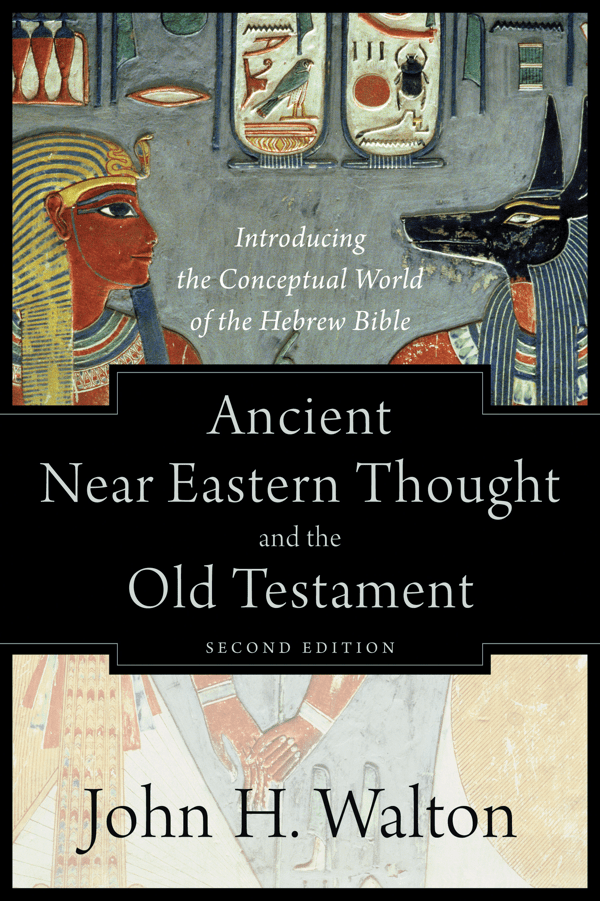
Few within evangelical scholarship have attained the heights of John H. Walton. His influence in Old Testament studies is prominent in both academic and general readership publications. The fact is exemplified by his editorial position on several major commentary and multi-volume encyclopedia works, alongside his own mountain of monographs, to which a new volume is added almost annually.1 Walton taught at the conservative Moody Bible Institute for twenty years before coming to the more broadly evangelical Wheaton College in 2001. He remains there another two decades later. None could deny that his knowledge, experience, and expertise in the Old Testament are vast.
Walton’s scholarship has, like anyone’s, also followed a trajectory over his career. What he has moved from is a decidedly grammatical-historical hermeneutic, with a high value on inspiration and authorial intent.2 What he has moved toward is a hermeneutic that, more than merely incorporating the social sciences and comparable ANE texts, seems to privilege them over against the Bible’s own voice. Indeed, in Walton’s view the Bible’s meaning is “lost” unless one reads it alongside a host of other ANE texts. Experts like him can recover what is lost to the rest of the church. In practice, he does not seem to align with other evangelicals’ commitments either to the inner-biblical hermeneutic of biblical theology or to the doctrine of divine illumination as sufficient for understanding Scripture’s basic meaning today.
These are essentially the problems I see with Walton’s approach in the second edition of his influential book Ancient Near Eastern Thought and the Old Testament (hereafter ANETOT).3 In a nutshell, for Walton, the ANE can interpret the Bible, but the Bible can only marginally interpret the ANE, if at all. The ANE is more authoritative; it retains the priority. That problem is worked out in several specific issues, which I consider below. But first, some positives.
A Few Positives
Walton begins in Part 1 by stating his objective and giving an apologetic for the fact that his book does “not take an apologetic approach” (30). He aims only “to improve the exegetical analysis of the Old Testament” through the culling of data from the ANE (30). And cull data he does. Besides the abundant sources that he cites, which I found helpful, I also found helpful and I learned from Walton’s analysis of the OT on several subjects. These are, at least, the below:
- ANE insights into the Tower of Babel (80–81),
- how Israel’s worldview differed from ANE beliefs in what Walton calls the “control attributes”; i.e., the universe (e.g., magic, superintendent parameters; cf. 57–60, 161–65),
- the distinction between Israelite and ANE values in historiography (e.g., ANE’s value of legitimation of the king vs. the Bibles’s value of covenant, 205, 207),
- the centrality of covenant in Israelite life and thinking (passim, 205, but especially vis-à-vis the concept of law, 274–75, 280–81),
- the uniqueness of Yahwistic theodicy (288), and
- the unique hope which the Israelite form of prophecy held out to hearers for covenant-based restoration after judgment (228).
However, while I did find in ANETOT an abundance of valuable information and a few helpful insights, in my judgment Walton’s method is seriously flawed. Thus, his application of ANE comparative analysis was more often confusing than enlightening.
False Neutrality
Methodologically, Walton attempts to be neutral between what he calls the “critical or defense roles” regarding the OT’s veracity (30). Yet on balance, his conclusions could hardly be called neutral; they show far more interest in revising traditional or confessional exegesis than in revising the conclusions of historical criticism (e.g., 24–27, 57, 209, 294n4, 311, 312). As the book’s “Comparative Explorations” bear out, Walton in fact overhauls a great deal of past exegesis on the basis of recovering the “lost world” of ANE thought, and this, even though some of the exegesis he overturns is at least as old as the NT (e.g., the seven days of creation [148, 152–53, 58–59], the geography of Eden [84–85], the “tablet of the heart” [234–35], the Messiah in the Psalms [!, 267], etc.).
Walton previews a bias against Christian interpretation in particular in chapter 1, saying, “As much continuity as Christian theologians have developed between the religious ideas of preexilic Israel and those of Christianity, there is probably not as much common ground between them as there was between the religious ideas of Israel and the religious ideas of Babylon” (13, emphasis mine; cf. his remarks on 310–12). While he then lists examples from a few cultic aspects of “Israelite practice” rather than its theology, the analysis throughout the book shows that “religious ideas” in chapter one is a pregnant term, meant to include theology. From the start, whatever Walton’s approach may be, any assumption that Israel’s religion was closer to Babylon than to Christianity cannot, by definition, be evangelical. Evangelicals understand the Bible , Old Testament included, as Christian Scripture.
Moreover, for this book at least, Walton purposefully distances himself from “Christian theologians,” from the claims of the Old Testament to be divine revelation, and from the implications that such claims, if true, have upon exegesis. Rather, he attempts to treat the OT strictly as Israel’s “religion.” Nowhere is this put more candidly than in his explanation of the function of myth in the ANE:
For the Israelites, the stories in the Old Testament served a similar function. Yahweh was real to them and his deeds were important. Like everyone else in the ancient world, the Israelites believed that everything that happened and everything that existed found its cause in deity. In this way of thinking, it is irrelevant whether the modern reader believes the gods of the Babylonians or the God of Israel exist. The significance and nature of the literature are not dependent on our assessment of their reality. These accounts serve as important sources for coming to understand the worldview of the ancients. For those who continue to accept aspects of that worldview—that is, one in which the role of deity is pivotal—there is added significance. That is why those who continue to believe in the God of Israel would not classify the Old Testament accounts and the ancient Near Eastern myths in quite the same category. But for those who have no convictions concerning the God of Israel the differences fade into insignificance, because the God of Israel is just as imaginary as the gods of Egypt or Assyria. (34, emphasis mine)
Walton seems to believe that for understanding Israel’s worldview (and improving the exegesis of the OT), it is unimportant whether a certain Yahweh did or did not historically reveal Himself to Israel. He was real to them, and that is what mattered. Their worldview was real, but their basis for that worldview was irrelevant for the interpretive process. In such a way, Israel must be analyzed on an equal plane with her neighbors, according to Walton’s view, whatever they believed and however much it did or did not correspond to reality. The only reason one worldview could have more significance than another is a matter of subjectivity; it is not inherent in the worldviews themselves.
Yet, it seems to me that such an analysis of an author’s worldview—an analysis that separates beliefs and thought patterns from their bases—does not ultimately deepen the exegesis of the OT but shallows it out. It does so at precisely the most exegetically significant point, the “why.” Certainly, Walton brings forward a vast amount of data regarding other ancient cultures, literatures, and religions into the discussion, by which the reader is improved. But if, to use the illustration, the emperor has no clothes, then the obviously false nature of his beliefs, however sincere, must inform the analysis of his worldview from the outsider’s perspective. The observer need not pretend that the emperor’s nakedness is irrelevant in order to understand the worldview behind it. Quite the opposite is true; the emperor’s credulity toward (or willful delusion in) a deception reveals what he values and how he organizes his thoughts about the world. It reveals his integrity or lack thereof with other subjects.
But Walton would have his readers set aside the question of whether either Israel’s interactions with Yahweh or Babylonia’s interactions with their pantheon are credible historical realities, and only then would he have us compare the worldviews of the two cultures. He seems to believe that (or at least attempts to operate as though) the fact of God does not enlighten a worldview investigation but clouds it.4 With this I cannot agree.
Further for Walton, Israel’s worldview, communicated through the OT and its religion, must be approached a priori as a construct and development of “conventional ways of thinking” in the ANE (6). Such thinking, for Walton, means inherited ideas about the world, which Israel sometimes evolved to suit their own needs or theology (passim, e.g., 57; cf. evolutionary model of Yahwism promoted on pp. 102, 112–13, 248). Walton never tells us from where such theology arose. What he does assert is that the OT does not evince a divinely given worldview laid on the foundation of Yahwism. Rather:
Cultural foundations found in cosmology, ontology, and anthropology are not matters of revelation in the biblical literature. The basic defaults from the common cognitive environment are in place and generally represent the way Israelites thought. Certain modifications may have come about as a result of their theology, but the foundations show little evidence of innovation. (112, 114, emphasis mine; cf. 92)
To Walton, ANE thought was foundational, and, though Yahwism was clearly formative for Israel, it was less so than the ANE foundations. Yahwism affected ethics (119), theodicy, the cult, prophecy, and some eschatology (but see again 310–12). However, these realms were apparently less foundational (more superficial) than the current of thought already established by the polytheistic worldviews surrounding Israel. To Walton, Yahwism informed but did not control even Israel’s view of the nature of God (66, 71, 102–5).
Now, I certainly deny that cosmology, ontology, and anthropology are not matters of revelation in biblical theology. I maintain that they were. But the reality of certain “foundational” conceptual patterns of thought that all worldviews and cultures alike share is undeniable. In an ultimate sense, humanity shares one context to which all are bound, the created world, and one image in which all are made, the imago Dei. (This gives rise to what is in cognitive linguistics called the “embodied experience” commitment.5) Yet, I find the arguments of Jeffrey Niehaus entirely more satisfying as to the explanation for foundational thought patterns. Namely, they are that God built into the human psyche certain conceptual archetypes, included in general revelation, maintained by common grace, distorted by sin, but serving to anticipate the special revelation God would, at appointed times, bring into the world.6
Returning to the issue of neutrality, the audience for whom Walton writes seems to be non-evangelical, critical scholars, rather than the aforementioned Christian theologians, who bear the brunt of his negative criticism. Walton does not evaluate the two camps evenhandedly but seems to share, in part, the low view that he assumes his readers have toward the scholarship of “evangelical Protestants” in particular (24), handicapped by their confessions and by their presupposition that the Bible is inspired. (Of course, Walton is himself a confessing evangelical, yet apparently he did not believe that such an admission of his bias was necessary in ANETOT.) In his view, while some critical scholars have in the past resisted the comparative method to which he subscribes, confessional scholars are guilty of it more. The latter camp is often embodied in “apologists” who “have not had the scholarly training” to be discerning, are “insufficiently schooled” in the methods and tools necessary, and bring presuppositions to the exegetical process in a way that non-Christian, critical scholars do not (27).
Thus, when putting forward his integrated rules for the comparative method in chapter 2, Walton seems to think that critical scholars have the upper hand for achieving a neutral modus operandi. For, while, he admits, even critical schools create traditions (e.g., source critical, historiographical, 192–93), confessional schools remain accountable to them. Critical schools, on the other hand, seem to be accountable only to themselves; they are not confessional.
Consensus among confessional scholars is often based on tradition. These conclusions need constantly to be reevaluated with a critical eye by careful scholars who are not predisposed to either undermine or vindicate confessional conclusions. Consensus in critical circles has embraced theories that have created their own traditions, which need constant reevaluation. Comparative studies used for critical analysis can thereby provide a basis for us to subject our theories and traditions to accountability. (29, emphasis mine)
One can only suppose that by “confessional scholars,” Walton means Judeo-Christian; scholars of a non-Judeo-Christian persuasion either must not have confessions of their own or are not predisposed to vindicate them. Consistent through to the final sentence of the final chapter, Walton’s critique of critical scholars is generously broad by comparison to that of confessional scholars:
These points of continuity and discontinuity should have an important role in our interpretation of the Bible, and knowledge of them should guard against a facile or uninformed imposition of our own cognitive environment on the texts of ancient Israel, which is all too typical in confessional circles. This recognition should also create a more level playing ground as critical scholarship continues to evaluate the literature of the ancient world. (316, emphasis mine)
Walton sees evangelical Protestants as “often” and “typically” committing the sin of imposing a worldview on the text and allowing themselves to be misguided by their biases. Historical-critical scholars may critique one another, but toward the confessionalists, they simply need to play nice. Suffice it to say, a more integrative approach would have been for Walton to acknowledge his own biases—one would think in the introduction at least (!)—in a book as critical and as laudatory of neutrality as ANETOT. One gets the impression that the author was embarrassed by his confessional brethren. Like the rest of us, however, he is not above bias.
Data Surveyed
A less significant weakness in Walton’s method is an over-prioritization of the Assyrian and Babylonian worldviews—which together shared a pantheon, a language, and many cultural values—in his comparison to Israel’s worldview. In fact, the only ANE cultures that Walton consistently surveys are “Mesopotamia” (i.e., Assyria, Babylon) and Egypt (for which he relies disproportionately on the works of J. Assman), but a strong majority is the former (e.g., 208, 240–42, 260–65), which I think skews his analysis. Occasionally, Walton depicts the ANE as monolithic based on the Assyrian perspective in opposition to the Egyptian (e.g., 145). Granted, Egypt and Assyria provide the greatest quantity of records, but rarely does Walton venture outside of them. Wider surveys of data are provided by Niehaus7 and Block8 that also, thoroughly, and consistently consider the data from Sumer, Assyria, Babylon, Hatti, Canaan, and Canaan’s nearer neighbors. I also found better analysis of myth as it relates to cosmology and cosmogony in Oswalt9 and Hoffmeier.10
Doctrine of Scripture
Finally, in ANETOT Walton obfuscates the doctrine of Scripture. For example, he believes that prophets may at times have been mistaken in their understandings of ANE idols (76). He implies that certain theophanies were imagined or recast imaginatively in depictions not corresponding to reality (136). He asserts that somehow Scripture “distances itself” from ANE theology but still “communicates within the ancient perspectives,” e.g., of cosmology, though those perspectives are scientifically false and based in false religions’ cosmogonies (160). It would seem largely impossible to unweave the “ancient perspectives” of cosmology (at least those Walton focuses upon) from theology. The Israelites, in Walton’s view, were apparently uninterested with the material-historical facts of creation but “imagined” the universe as they described it in the OT according to how they functionally experienced it (148, 158, 168). Likewise, he says that the Chronicler “may have had neither the means nor the inclination to investigate the factual accuracy of some of his sources’ details” (208, cf. the approving citation of Bottéro: “people who had neither our need for logic nor our demands for clarity,” 66), and then warns that “confessional scholars need to rethink precisely what constitutes the truth of the text that they seek to defend in light of the text’s own poetics and perspectives” (209, emphasis mine). Such an appraisal of “poetics” belies a view of the ancients’ intellect that is too low (as essentially ambivalent toward fact) or else a view of false theologies that is too benign and romantic.
Walton also demonstrates a weakened view of Scripture. He treats the themes of the OT atomistically, not in their canonical context of biblical theology (i.e., progressive revelation, which is distinct from the evolution of religion; cf. his curious conclusion about the Messianic Psalms on p. 267). Though at points of similarity Walton avoids saying that Israel “borrowed” texts or concepts from the ANE, it seems hard to avoid that conclusion to his arguments in favor of an Israelite “modification,” “evolution,” or “adaptation” of ANE thinking (cf. my comments on 262–65, 288). At any rate, the OT authors cannot seem, in Walton’s view, to rise above the “standard literary conventions” common to their environment, even if they were able to modify the thought patterns and theology in their environment (199, 206, e.g., 1 Sam 28 on p. 307). One wonders how one could be surmountable but not the other. Personally, I find Currid’s argument for the OT expressing many polemical, even satirical uses of ANE concepts and metaphors to have much greater explanatory power than Walton’s approach.11 This also helps to explain the motivation, for example, behind a biblical text that may have rewritten a pagan text, giving it Yahwistic theology instead (e.g., Ps 29, cf. the “Baal Cycle” from Ugarit). It was not an evolving or surreptitious borrowing of literature, nor any conventional-foundational thinking that lay behind such intertextuality, but an overt, conscious polemic against the false gods of the nations.
Chapter 9 in particular is an expression of Walton’s departure from mainline evangelical views of Scripture (at least historically) by his belief in evolutionary creationism. While Walton does not deny the possibility of Adam and Eve being historical individuals, he advances the understanding of them as archetypal and of Genesis 2 as “an account of human identity rather than an account of human origins” (178). Incidentally, regarding the NT, Walton overlooks Adam’s mention in Mark 10:6 and Luke 3:38 as the genetic ancestor of humanity, and he misinterprets the citation of Adam and Eve’s sin in Romans 5 as being significant for the human race “because they are archetypes, not because they are genetic parents” (179). In fact, their sin is significant on both accounts (cf. physis, “nature” in the NT). But Walton prefers to view mankind as created in population first and in individuality second (180). He takes up the full defense of this view elsewhere.12
Besides, then, having a view of the OT’s authors’ and audience’s intellect that, in my judgment, is unnecessarily low, Walton seems also to deny a verbal, plenary, concursive definition of the OT’s inspiration. How divine revelation fits into the OT, either in Walton’s view or Israel’s, is unclear throughout the book. One would think that “Scripture” or “canon” were concepts worthy of analysis in a comparative analysis (at least for the sake of Israel’s uniqueness), but the closest that Walton gets to it is via “covenant” in chapter 13 (where his discussion mainly concerns whether ANE instruction and the Torah may be considered “law,” esp. 280–81[!]). Addressing “sacred texts” as a concept in its own right would have made Walton’s view clearer with respect to where divine revelation and inspiration might overrule the influence of ANE patterns of thought for Israel.
Conclusion
In summation, ANETOT is rich with sources and information, and it is provocative. On balance, however, it confuses more than clarifies the relationship between ANE thought and the OT, if the OT is to be acknowledged as inspired Scripture. It does not improve OT exegesis, because it does not integrate the OT’s own view of itself. At least in this work, Walton has checked any attempt to uphold an evangelical view of Scripture. Thus, the book’s primary flaw is methodological. In its argument, one must understand the ANE first, and then he can understand the OT. In my view, the OT is primary for understanding the ANE. This is not to say that ANE history, culture, and customs cannot illuminate the details of the OT; it can. But special revelation must remain the “spectacles”13 by which fallen men ultimately interpret general revelation, including history, culture, and cognitive environments.
Endnotes
- E.g., John H. Walton, Victor H. Matthews, Mark W. Chavalas, The IVP Bible Background Commentary, vol. 1, Old Testament (Downers Grove, IL: IVP Academic, 2000); John H. Walton, Zondervan Illustrated Bible Backgrounds Commentary on the Old Testament, 5 vols. (Grand Rapids: Zondervan, 2009); John H. Walton, The Lost World Series, 7 vols. (Downers Grove, IL: IVP Academic, 2009–2019); Jonathan S. Greer, John W. Hilber, and John H. Walton, Behind the Scenes of the Old Testament: Cultural, Social, and Historical Contexts (Grand Rapids: Baker Academic, 2018); Andrew E. Hill and John H. Walton, A Survey of the Old Testament, 4th ed. (Grand Rapids: Zondervan Academic, 2024). ↩︎
- E.g., John H. Walton, “Inspired Subjectivity and Hermeneutical Objectivity,” The Master’s Seminary Journal 13, no. 1 (Spring 2002): 65–77. ↩︎
- John H. Walton, Ancient Near Eastern Though and the Old Testament: Introducing the Conceptual World of the Hebrew Bible, 2nd ed. (Grand Rapids: Baker Academic, 2018). ↩︎
- Eta Linnemann, Historical Criticism of the Bible: Methodology or Ideology? Reflections of a Bultmannian Turned Evangelical, trans., Robert Yarborough (Grand Rapids: Kregel, 2001), 84. ↩︎
- Cf. Vyvyan Evans, Cognitive Linguistics: A Complete Guide, 2nd ed. (Edinburgh: Edinburgh University Press, 2019), …. ↩︎
- Jeffrey J. Niehaus, Ancient Near Eastern Themes in Biblical Theology (Grand Rapids: Kregel Academic, 2008), 29–30. ↩︎
- Niehaus, Ancient Near Eastern Themes in Biblical Theology. ↩︎
- Daniel Block, The Gods of the Nations: A Study in Ancient Near Eastern National Theology, 2nd ed. (Eugene, OR: Wipf & Stock, 2013). ↩︎
- John N. Oswalt, The Bible among the Myths: Unique Revelation or Just Ancient Literature? (Grand Rapids: Zondervan, 2009). ↩︎
- James K. Hoffmeier, “Genesis 1–11 as History and Theology,” in Genesis: History, Fiction, or Neither? Three Views on the Bible’s Earliest Chapters, ed., Charles Halton, Counterpoints: Bible and Theology (Grand Rapids: Zondervan, 2015), 23–58. ↩︎
- John D. Currid, Against the Gods: The Polemical Theology of the Old Testament (Wheaton, IL: Crossway, 2013). ↩︎
- John H. Walton, The Lost World of Genesis 1: Ancient Cosmology and the Origins Debate (Downers Grove, IL: IVP Academic, 2009), esp. 116ff. ↩︎
- Calvin, Instit. 1.6.1. ↩︎


Leave a Reply