Bible Study, Triniy Bible Church Cypress, May 24, 2026
I. Why TULIP?
A. Historical Flyover
The Reformation in the Netherlands—or, as it was then known, the Dutch Republic—was magisterial, just as in the other major European contexts (e.g., Germany, Switzerland, Geneva, England). It was also “utterly entangled in disputes over the Republic’s foreign policy.”[1] The Dutch-speaking provinces of the former Holy Roman Empire were embroiled in The Eighty Years’ War with Spain, and this played a significant role in what led to the Synod of Dort and the so-called “Five Points of Calvinism.” A flyover of events will summarize the situation.
1555 – Philip II of Spain inherits the Holy Roman Empire, Charles V. It was Charles V who declared Martin Luther an outlaw at the Diet of Worms (1521). Philip, taking up his father’s mantle, becomes the international sponsor of the Counter-Reformation. Biographers describe him as bent on proving himself a better Catholic than the pope.[2] Under his commission, the Spanish Inquisition kills thousands of Dutch Protestants in the years that follow.
1571 – Dutch Protestants call a national synod at Emden. They call themselves “the Reformed Churches,” and adopt a presbyterian form of government (of consistory, classis, and synod).
1574 – A national synod adopts the Belgic Confession, though it had earlier been adopted by at least one regional synod.
1575 – The parents of 15-year-old Jacobus Arminius are killed in a Spanish massacre at his hometown of Oudewater. He is orphaned by well taken cared for.
1576 – The northern provinces finally drive out the Spanish, and form the Dutch Republic.
1580–81 – The now 20-year-old Arminius is funded by the Amsterdam merchant guild to study under Theodore Beza, among his other studies abroad. Beza was Calvin’s successor at the Geneva Academy, and well known for articulating the supralapsarian (i.e., equal ultimacy or symmetrical) view of predestination. There had, however, long been a Dutch humanist tradition in Arminius’ context with a high view of human free will (e.g., Roman Catholicism, Desiderus Erasmus). These were irreconcilable.
1589 – An international scholarly debate on predestination arises between Arminius’ countrymen and his former dean, Beza. Arminius is asked to write something in Beza’s defense, but he abstains.
1603 – Arminius is appointed professor at Leiden, a recently founded, Protestant university of the Dutch Republic. There he begins openly objecting to the Belgic Confession (which had been adopted by a national synod in 1561). His objections incite a public inquest from the Reformed church authorities. He then asks his allies in the state to call a national synod for debate. (He is also pro church-and-state and pro truce with Spain.)
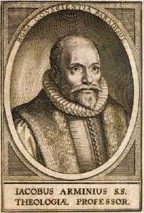
1609 – The Twelve Years’ Truce begins in the war with Spain. The reprieve from war allows the homegrown theological conflict to be handled. But Arminius dies of tuberculosis, never getting the debate he requested.
1610 – Some 43 Arminian ministers gather to write up their defense and appeal for toleration in the Republic. They called it “A Remonstrance to the States-General” (i.e., the federal council). It was a short document, little more than 500 words in Latin. It named five points objected to in various Calvinist works.
1611 – Both parties are summoned, debate, and become known thereafter as Remonstrants and Counter-Remonstrants.
1617 – Political conflict and intrigue reach a breaking point. The two parties are entrenched in different provinces; though, the majority of clergy in the country are Counter-Remonstrant (Calvinist). Remonstrant provincial governments, especially in the capital province (Holland), depose Calvinist ministers, and, when disobeyed, confiscate their alternative meeting places. Calvinist crowds riot and sack Remonstrant homes. Remonstrant provinces, then, raise militia—and the stakes. The commander of the federal army, who is Counter-Remonstrant as a political expedience, disarms the provinces, executes or imprisons his enemies, and installs his allies. A number of the most significant contributors to the Reformation in the Republic are forced to live in exile.
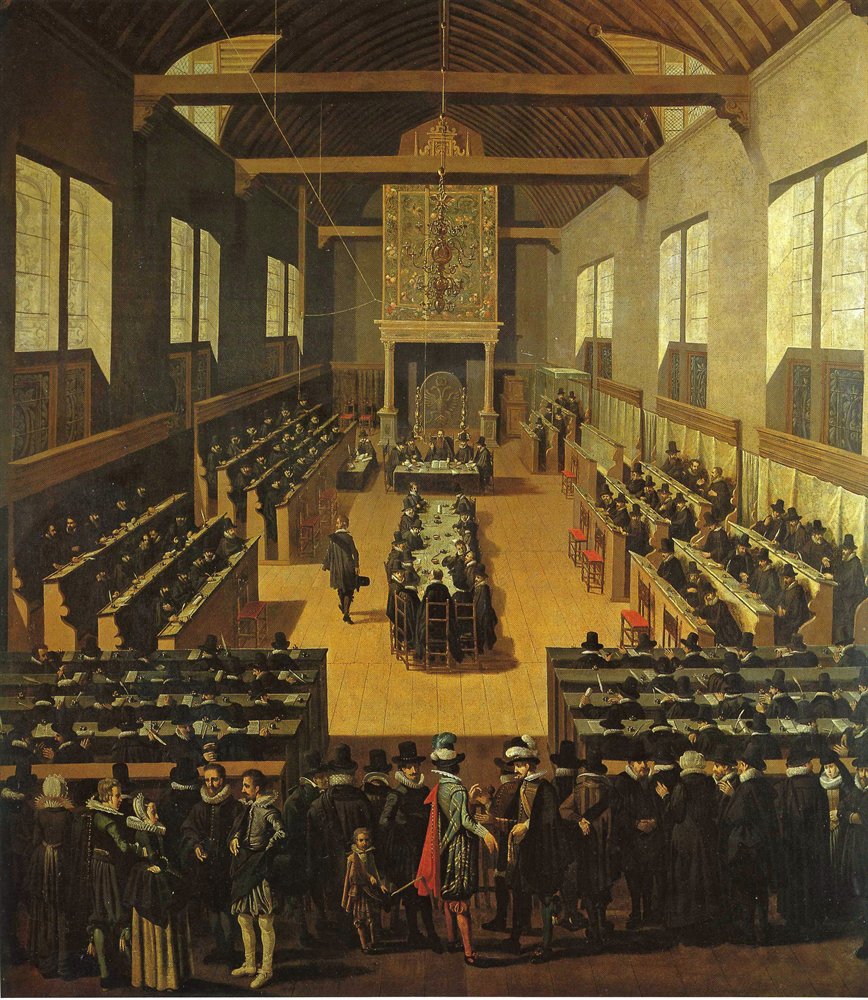
1618–19 – The States-General call for a final national disputation at the Synod of Dort. It was really an international Calvinist assembly, and a bit auspicious. Some 105 delegates were present over two months.[3] At least 26 of them were invited from England, Germany, and Switzerland. The French Huguenot churches were also invited to send delegates, but Louis XIII prohibited them from attending.
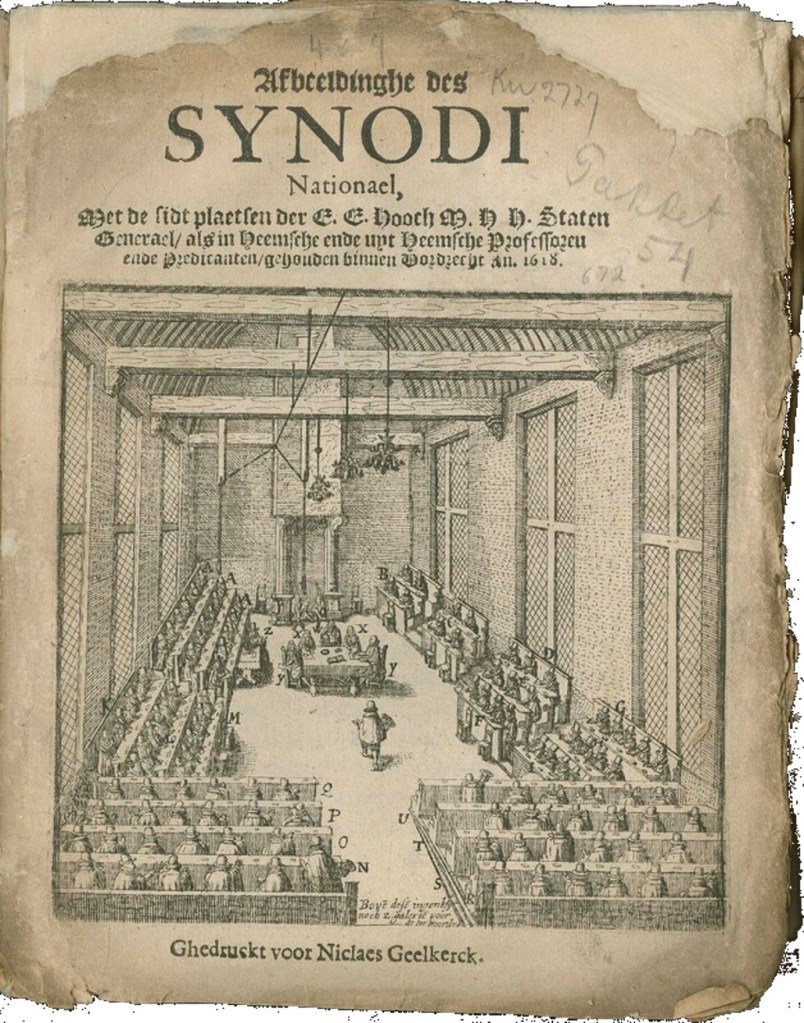
Below are two images depicting this event. On the left is the title page of a pamphlet printed in Dort, 1618. The image is sketch of the assembly hall. The seating places of the various delegates are letter-coded to a key inside the pamphlet, much like you might see in historical photographs today. On the right is a painting of the same, published two years later, 1621, which became famous thereafter. Notice the empty seating area along the right side of the hall. It was left open for the French delegates who never came. It’s a reminder of the political battle that the Reformation was, involving kings and nations.
Once the convocations were given and the rules and agenda set, 13 Remonstrants were summoned. Although a large cohort arrived, only those summoned were allowed into the assembly hall. They were engaged as defendants for doctrinal error. At length, they were deposed or exiled (until tolerated again in 1625).
The synod also passed the five Canons of Dort as official doctrine. This was a much longer, fuller document than the Remonstrance was. Here, then, are the five articles of the Remonstrance and the corresponding Canons—at least as they later became known, as the five points of Calvinism (“TULIP”).
B. Comparison Table
| The “Arminian” Remonstrance[4] | The “Calvinist” Canons (→TULIP) |
|---|---|
| 1. That God elected to save sinners whom He foreknew would believe and persevere; and to reject the unconverted | Unconditional election |
| 2. That, therefore, Christ died for all and every man, obtaining reconciliation and pardon for all, but only the faithful enjoy it | Limited atonement |
| 3. That fallen man cannot obtain saving faith of his own free will, but stands in need of God’s grace through Christ to be renewed | Total depravity |
| 4. That cooperating grace is essential to faith and perseverance (and thus all good works are ascribed to grace), yet it is not irresistible | Irresistible grace |
| 5. That true believers have sufficient grace to persevere, but whether they might apostatize and forfeit grace need be investigated further | Perseverance of the saints |
Now, the acronym “TULIP” was not used by the Synod of course. That was later, and obviously quite simplistic. Calvinist doctrine is much broader than the five points of the “doctrines of grace” or God’s sovereignty in our salvation. But Calvinists have used the nickname because of its popularity, much like the term “Calvinist” to begin with.
On that note, as we transition from our biblical to our systematic theology, I would make three applications up front.
First, it should be fair to say that both sides, Arminians and Calvinists, are not lionizing a champion simply by using those titles. Nevertheless, we should each be reminded not to do so. What is decisive is the truth found in Scripture, not the pedigree of the argument. I’m not dismissing church history at all. But church history has a ministerial voice, not a magisterial one. No Reformer (or camp of Reformers) must be permitted to displace Christ’s authority or affection in our hearts.
Second, recognize that a right understanding of these five points does not make or break anyone’s salvation. I agree with Andrew David Naselli that predestination is a “second tier” issue.[5] Neither of these two sides, Calvinism or Arminianism, in their classical forms deny the gospel. Either may be extended to extreme positions that do, but that is not what we are dealing with here. Plus, it is recognized by both sides that most evangelicals today who do not ascribe to Calvinism (a) don’t ascribe to Arminianism either and (b) probably aren’t aware of most of what Arminianism argues, though they may call themselves Arminian.[6] Therefore, divisiveness and assumptions are the wrong response to the other side.
Third, I would remind us to think with grace—and, I dare say, more grace than the Reformers did with each other. In my experience, just the word “Calvinist” or “Arminian”—like “Remonstrant” or “Counter-Remonstrant” back then—like “dispensational” or “covenantal” today—is enough to make the blood boil in many of us. It is like a trigger to look down our long noses with scorn at the brother or sister for whom Christ died. We’re triggered to think them and their thoughts unworthy to be considered, to love them less, to judge them more—ironically, as small-minded or conceited. But God forbid! Christ loves your brother in word and deed and thought. So must you.
As we go step-by-step through these five points, maybe you are not persuaded of Calvinism. Be generous. Maybe you are offended by the Arminians I quote. Be generous. (And do so without telling yourself you are being generous.) Let’s begin.
II. Total Depravity
A. Summary Statement
“As a result of Adam’s fall, the entire human race is affected; all humanity is dead in trespasses and sin. Man is unable to save himself.”[7]
Now, by “total depravity” is not meant “utter depravity.” It is not as if every man is as depraved as possibly could be. But “total” is meant as encompassing the entire race and entire person. The word “depraved” does not often appear in our English versions. For example, the NET Bible uses it twice in the NT (Rom 1:28; Gal 5:19). The ESV uses it elsewhere and only once in the NT (1 Tim 6:5). It is simply a synonym for “debased, corrupted, crooked.”[8] Therefore, we get the following alternate names.
B. Alternate Names
- Radical corruption (< Lt. radix “root”)[9]
- Pervasive corruption
- Total inability
(Although, the latter is more the effect of depravity, with respect to faith.)
C. Scriptural Basis
Gen 6:5; 8:21; Pss 51:5; 53:1–3; 58:5; Jer 13:23; 17:9; Matt 12:33–37; 15:18–19; John (3:3; 6:44, 63–65) 8:34; Rom 3:10–18; 5:12, 18–19; Eph 2:1–3; 4:17–19.
D. Explanation
Genesis 6
The most basic and comprehensive statement comes shortly after the fall in the storyline of Genesis. Adam and Eve are expelled from the garden. There is hope of a redeemer. But all men die, without exception. And as men fill the earth and subdue it, so does their evil.
Gen 6 – 5 Then Yahweh saw that the evil of man was great on the earth, and that every intent of the thoughts of his heart was only evil continually. 6 And Yahweh regretted that He had made man on the earth, and He was grieved in His heart. 7 And Yahweh said, “I will blot out man whom I have created….”
This doesn’t say that every thought was evil, as if man could never have a non-evil thought. It says the “intent” behind every thought was evil. It’s a word that means formation with a purpose.[10] The same is used of a potter forming pottery (Isa 29:16) and of God forming man (Gen 2:8). It means the motivations of man’s heart were always evil.
Genesis 8
We see that the Lord’s appraisal wasn’t merely referring to the flood generation, but all mankind. After the flood, Noah disembarks the ark and offers a sacrifice.
Gen 8:21 – And Yahweh smelled the soothing aroma; and Yahweh said to Himself, “I will never again curse the ground because of man, for the intent of man’s heart is evil from his youth….”
Psalm 51
This psalm is, of course, David’s confession and plea for mercy after his sin with Bathsheba.
Behold, I was brought forth in iniquity,
And in sin my mother conceived me. (Ps 51:5)
Calvin says of this verse, “[David is] aggravating his guilt, acknowledging that he had not contracted this or that sin for the first time lately, but had been born into the world with the seed of every iniquity.”[11] Spurgeon says of the verse, “The fountain of my life is polluted as well as its streams.”[12]
This being “evil from one’s youth” and “conceived in iniquity” is an essential part of what radical corruption means, and it continues in the NT.
Romans 5
Rom 5 – 12 Therefore, just as through one man sin entered into the world, and death through sin, and so death spread to all men, because all sinned—13 for until the Law sin was in the world, but sin is not imputed when there is no law. 14 Nevertheless death reigned from Adam until Moses, even over those who had not sinned in the likeness of the trespass of Adam, who is a type of Him who was to come.
18 So then as through one transgression there resulted condemnation to all men, even so through one act of righteousness there resulted justification of life to all men. 19 For as through the one man’s disobedience the many were appointed sinners, even so through the obedience of the One the many will be appointed righteous.
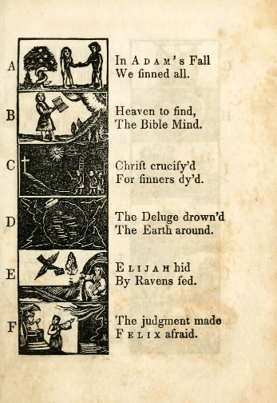
There is a famous rhyme from The New England Primer 1777. That was a schoolbook for young children learning to read. With their ABC’s, for the letter A the Primer’s rhyme says: “In Adam’s fall, we sinned all.”[13] That is Paul’s point in Romans 5. In theology, it is called original sin. Original sin is “original” because it occurred at the origin of the human race, and is “original” because it stands behind our “actual” sins (the sins we commit in our lifetime).[14]
The point is well said: “I’m not a sinner because I sin; I sin because I’m a sinner.” For, v. 12 says the reason death spread to all men is “because all sinned.” Then, v. 14 says that—even without sinning in the same way as Adam or against the same “law” (i.e., the law of God’s direct, audible command) that Adam had—every human has always been born with the guilt of sin and germ of death within them. Thus, v. 19 says, all of us are “appointed” (ESV: “counted as”) sinners in Adam’s sin.
We can conclude from this, for one, that we participated in Adam’s sin, since he is our natural head (i.e., we were in him organically). For example, the author of Hebrews speaks of Levi making tithes to Melchizedek, and thus the priestly line paying tithes to the priest who was without lineage. For, the former (both the Levitical priests and Levi himself) were “in the loins of” their father Abraham when Melchizedek met him (Heb 7:1–10; Gen 14:17–20). This is a view called realism. But we are also imputed Adam’s guilt, because he is our representative head. God considered him a figurehead to all of humanity that would follow after him, and God thereby imputes to us an alien guilt, to which we add our own. This is a view called federalism. Both views are true and compatible.
Then, because God established this basis of imputation, He also imputes to those of faith an alien righteousness. It is the righteousness of our new representative head, Jesus Christ. It is through this same paradigm that I am saved, and without which I cannot be saved. In this way, v. 14 says, Adam was a “type” of Christ. Hence, Paul elsewhere calls Christ the “last Adam” (1 Cor 15:45).
Ephesians 2
Eph 2 – 1 And you were dead in your transgressions and sins, 2 in which you formerly walked according to the course of this world, according to the ruler of the power of the air, the spirit that is now working in the sons of disobedience, 3 among whom we all also formerly conducted ourselves in the lusts of our flesh, doing the desires of the flesh and of the mind, and were by nature children of wrath, even as the rest.
I once attended a Baptist church in Fort Worth, where the well-meaning preacher was exhorting the congregation to fulfill the church’s mission and spread the good news of Jesus Christ. He said it was like the church was on the shore of a big lake. In the lake were many desperate, drowning people. And Christ left the church one job: “Get people out of the lake. Don’t beautify the shore, just get people out of the lake.”
Perhaps you’ve heard similar illustrations. Namely, that sinners are drowning without Christ. They need you to throw them a life saver, and it will be their choice whether to lay hold of it or not. These are well meaning and indeed have parts of the truth. But they are not what Ephesians 2 describes. According to these verses, the lake image would only work if the sinner is dead to begin with, at the bottom of the lake, and the Holy Spirit makes him alive. (The other details are difficult to allegorize.)
But to be “dead in [our] transgressions and sins” means to be without spiritual life of any kind:
- “darkened in mind” and “alienated form the life of God” (Eph 4:18)
- blind and deaf and stone-cold hard-hearted (Isa 6:10)
- completely unable to discern spiritual things (1 Cor 2:14).
It requires the kind of regeneration that Scripture illustrates with:
- a heart transplant (Ezek 36:26; cf. Deut 29:4; 30:6).
- a resurrection from the dead (Ezek 37; Eph 2:4–6).
- a new creation (2 Cor 5:17).
- a new birth (John 3; 1 Pet 1:3).
I will let Roger Nicole sum up:
Evil does not corrupt merely one or two or certain particular avenues of the life of man but is pervasive in that it spreads into all aspects of the life of man. It darkens his mind, corrupts his feelings, warps his will, moves his affections in wrong directions, blinds his conscience, burdens his subconscious, afflicts his body. There is hardly any way in which man is called upon to express himself in which, in some way, the damaging character of evil does not manifest itself. Evil is like a root cancer that extends in all directions within the organism to cause its dastardly effects.[15]
Now having explained the doctrine. Let me refine but answering some objections from our Arminian side of the family, in question form.
E. Implications and Objections
1. What is “prevenient grace”?
We’ve already encountered this word for weeks now. “Prevenient” comes from the Latin praevenire “to go before.” Originally this was a phrase used by Augustine for regeneration, which “goes before” faith and repentance. But it was then co-opted into meaning something opposite to what Augustine meant, until fully developed Arminianism. At this juncture, the classical Arminian definition contradicts what Scripture teaches about man’s spiritual state before conversion.
I would like to show you that so that (a) you don’t wonder whether I’m misrepresenting the other side, and (b) there’s no confusion about what Arminianism actually teaches.
Roger Olson is probably the leading evangelical scholar of Arminianism today. In his book Arminian Theology he writes this:
Arminianism teaches that all humans are born morally and spiritually depraved, and helpless to do anything good or worthy in God’s sight without a special infusion of God’s grace to overcome the effects of original sin. … Classical Arminianism agrees with Protestant orthodoxy in general that the unity of the human race in sin results in all being born ‘children of wrath’ [Eph 2:3]. However, Arminians believe that Christ’s death on the cross provides a universal remedy for the guilt of inherited sin so that it is not imputed to infants for Christ’s sake.[16]
Christ’s atoning death on the cross removed the penalty of original sin and released into humanity a new impulse that begins to reverse the depravity with which they all come into the world.[17]
He explains further on:
Prevenient grace is simply the convicting, calling, enlightening and enabling grace of God that goes before conversion and makes repentance and faith possible. … Arminians interpret it as resistible; people are always able to resist the grace of God, as Scripture warns (Acts 7:51). But without prevenient grace, they will inevitably and inexorably resist God’s will because of their slavery to sin.[18]
Finally, he says:
The person who receives the full intensity of prevenient grace (i.e., through the proclamation of the Word and the corresponding internal calling of God) is no longer dead in trespasses and sins. However, such a person is not yet fully regenerated. The bridge between partial regeneration by prevenient grace and full regeneration by the Holy Spirit is conversion, which includes repentance and faith. These are made possible by the gift of God, but they are free responses on the part of the individual.[19]
This is serious language. It means one could die while being spiritually “no longer dead” but “not yet alive.” However, there is no category in our physical reality that corresponds to this. Nor is there a text of Scripture given to support these precise assertions. Rather, they are deduced from an attempt to understand Scripture’s implications of human free will and its passages that speak of “all men” receiving some kind of grace or benefit from Christ (e.g., John 1:9; 12:32; 16:8; Titus 2:11).[20] It is an honest attempt, I trust made in good faith. Yet in so doing, the Arminian must contradict what Scripture teaches elsewhere about our condition before conversion.
I suspect that Arminius and his followers took as their starting point for these thoughts what all believers recognize as common grace. Common grace is in distinction to special (saving) grace. Common grace is how God graciously cares for His creation. It is demonstrated in God’s promise in Genesis 8–9 to never again flood the earth but to maintain its seasons, memorialized with the rainbow. Psalm 145:16 says God opens His hand and satisfies the desire of every living thing. As Paul and Barnabas preach in Acts 14:17,
“He did good and gave you rains from heaven and fruitful seasons, filling your hearts with food and gladness.”
Common grace even includes how God shows longsuffering and mercy to sinners, whom He has every right to blot out instantaneously.
“He causes His sun to rise on the evil and the good, and sends rain on the righteous and the unrighteous.” (Matt 5:45)
“He Himself is kind to ungrateful and evil men.” (Luke 6:35 NASB)
We swim through a sea of God’s common grace on every side.
“Every good thing given and every perfect gift is from above” (Jas 1:17)
It’s like the illustration: if you want to know what water is like, don’t ask a fish! I don’t even know how much grace I experience, moment by moment. But nowhere does Scripture say that this nullifies our corruption.
Admittedly, Arminians assert that prevenient grace is “not resident in nature, but a gift to nature.”[21] Yet, John Wesley—who was the greatest preacher of Arminianism and still looked upon as an essential systematician—blurred the lines between “what is vulgarly called natural conscience” and prevenient grace.[22] For him, conscience was distinct from “convincing grace, usually in Scripture termed repentance.”[23] But still, “it is not natural.”[24] Calvinists agree that conscience is a kind of grace—common grace—but nothing of the sort of “partial regeneration” or “degree of salvation”[25] that Olson, Wesley, and other Arminians deduce from Scripture. The middle ground of prevenient grace is, I think, a mix of common and saving grace, one that is not exegetically defensible.[26]
Rather, most emphatically, Paul says that it is our “dead[ness] in transgressions and sins” (Eph 2:1–3) into which the mercy, love, and grace of God break to make us alive together with Christ, raise us up together, seat us with Him, and save us (Eph 2:4–6). There is no middle ground between spiritually dead and fully alive ever hinted at in Scripture. In fact, none could be allowed by the clear contrast given in Ephesians 2 (where “dead in transgressions” is mentioned again in v. 4). To assert that there is a middle ground, a “partial regeneration” that removes some but not all guilt, goes beyond an argument from silence; it vitiates against the text and, indeed, against what regeneration means. The Arminian doctrine of prevenient grace should be abandoned.
2. Is man “able” to choose faith?
Being made in God’s image, God has granted to man a will. Yet, here is why “total depravity” is first in the Canons and in TULIP. If man is radically corrupt, then even his will is affected. Yes, man is made with the ability to choose what he pleases. In fact, I challenge you to test yourself for a while and see. In the simplest decision points about your day today, tomorrow, this week, you always choose what you think is the highest good in a situation. That’s true whether you’re choosing or refusing, approving or disapproving, commanding or forbidding. Even your decision to act or to abstain from acting is a choice. And even if you obstinately choose what is apparently the lesser good, just to prove yourself free from this paradigm, you will have proven it to be true anyway! For, disproving the paradigm was the greatest apparent good to you in that moment.
Jonathan Edwards in his book Freedom of the Will works this out, and summarizes this way: “The will is always determined by the strongest motive.”[27] Man, he says, has the natural ability to choose what he wants. But man does not have the moral ability to choose what God wants. In other words, man cannot change his wants to be God’s wants. His heart is corrupt.
Here is an illustration from Naselli’s book Predestination.
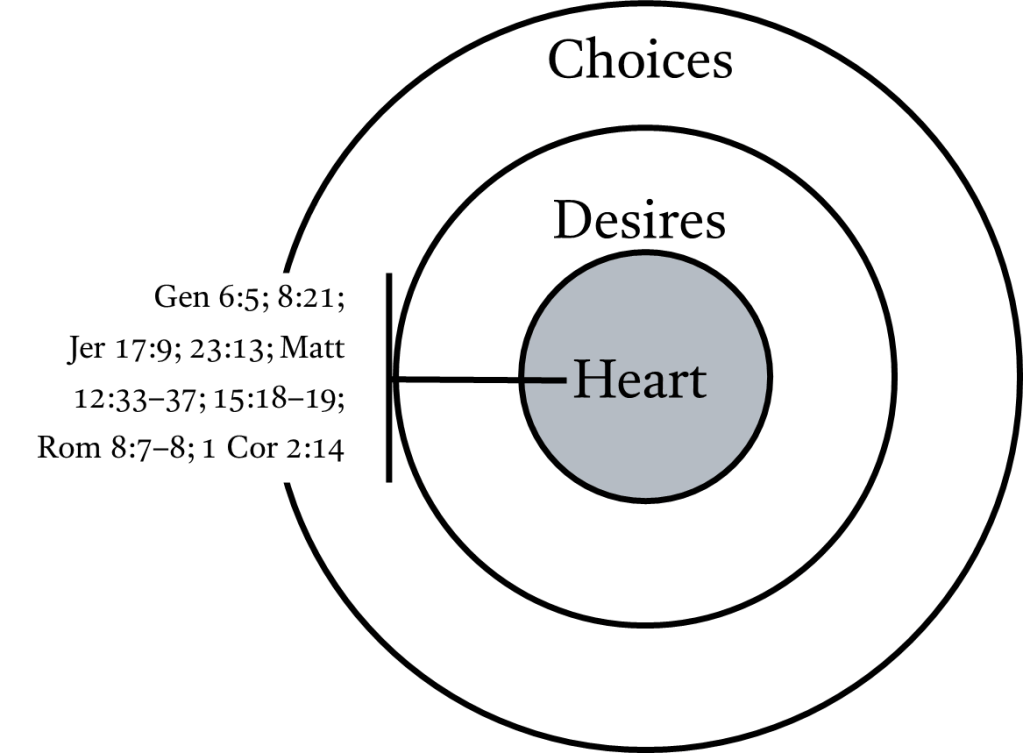
With it he gives this explanation:
“I always choose what I choose,
because I want what I want,
because I am who I am.”[28]
The point is that you cannot choose God until God changes who you are:
- transplants your heart of stone with a heart of flesh (Ezek 36:26)
- raises your spirit from the dead (Eph 2:4–6)
- re-creates your inner man as a new creation (2 Cor 5:17)
- and sets your will free from its slavery to sin (John 8:34–36)
Romans 8 makes this conclusion inescapable.
Rom 8:7–8 – …because the mind set on the flesh is at enmity toward God, for it does not subject itself to the law of God, for it is not even able to do so, and those who are in the flesh are not able to please God.
Man is morally unable to choose faith, even while his natural ability to choose what he wants is intact. Packer writes, “I am the morally responsible free agent; I am the slave of sin whom Christ must liberate; I am the fallen being who has it in me only to choose against God till God renews my heart.”[29]
As a consequence of these things—of our corruption being radical, making us unable to believe—election must therefore be unconditional.
III. Unconditional Election
A. Summary Statement
“God the Father chose to save specific individuals without basing his choice on the condition of faith.”[30]
B. Alternate Names
- Sovereign election
- Divine initiative
- Monergism (vs. synergism)
C. Scriptural Basis
John 1:12–13; 6:44, 63, 65; 15:16; Rom 8:28–29; 9:10–14; 1 Cor 1:26–28; Eph 1:4–11; 2 Thess 2:13; 2 Tim 1:8–11; Jas 1:18; 2:5; 1 Pet 1:1–4; 1 John 5:1, 4.
D. Explanation
Several of these passages we’ve already looked at in our NT survey, so I will lean on those classes. You can find them online. Let me just remind you with the following slide from last week.
| New Testament Survey (Epistles) |
|---|
| Rom 8 – golden chain of redemption; Who will charge “God’s elect”? |
| Rom 9 – election “depends not on human will or exertion, but on God” |
| Eph 1 – predestined “according to the good pleasure of His will” |
| 2 Tim 1 – called “according to… His own purpose and grace” |
| Jas 1; 2 – born “in the exercise of His will”; chosen “to be rich in faith” |
| 1 Pet 1 – chosen “to” obedience, “caused… to be born again” |
But we will add to these a few texts.
John 1
John 1 – 11 [Christ] came to what was His own, and those who were His own did not receive Him. 12 But as many as received Him, to them He gave the right to become children of God, even to those who believe in His name, 13 who were born, not of blood nor of the will of the flesh nor of the will of man, but of God.
Now, the grammar is not decisive here as to which happens first: receiving Christ, becoming children, believing, or birth. Let’s not get off track there. Yet, notice how John homes in three times on what new birth isn’t. It is “not of blood, nor of the will of the flesh.” Clearly this is spiritual birth, not physical. Then, is it “nor of the will of man, but of God.” Clearly, it is spiritual birth—but one that is divinely monergistic. That is a term meaning “the lone effort of one (person).” That person we learn in John 3 is the Holy Spirit. The new birth is not synergistic, meaning “the combined effort of multiple (persons).” In other words, only the will of God is the cause of this new birth.
Imagine a child giving effort in their own birth. The idea is impossible. Fathers cannot even claim to contribute to the delivery of a child. We support the mothers (as do doctors and nurses and midwives, etc.). But the imagery is of a single person’s effort, not two, and especially not the child.
1 John 5
One more text should show us that regeneration (the new birth) precedes faith.
1 John 5 – 1 Everyone who believes that Jesus is the Christ has been born of God, and everyone who loves the One who gives new birth loves also the one who has been born of Him.
John speaks of being born of God in two different verb tenses (i.e., timeframes). “Believes” is in the present tense, but “has been born” is in what we call the perfect tense. That simply means something viewed as a whole as being done in the past. John Stott writes in his commentary,
The combination of present tense… and perfect is important. It shows clearly that believing is the consequence, not the cause, of the new birth. Our present, continuing activity of believing is the result, and therefore the evidence, of our past experience of new birth by which we became and remain God’s children.[31]
The apostle John states this chronological order again in v. 4:
4 For everything that has been born of God overcomes the world; and this is the overcoming that has overcome the world—our faith.
Being “born of God” precedes faith in John’s theology.
Now, the reason this order matters is that the classical Arminian explanation of human free will is that the latter chooses God (i.e., believes, converts) before God makes the person fully alive. Yet, John 1 shows that human will is not a factor in the new birth, and 1 John 5 shows that human faith is not the cause of it either.
If we keep with the biblical illustration, try to imagine an infant choosing its parents before its birth. Infants cannot choose their parents, much less even to be born. That seems to be why God chose this picture for the miracle of regeneration. It is a miracle that He works in us alone. We cannot choose our Father; He must choose us.
Now, again, to some objections from our siblings who see things differently.
E. Implications and Objections
1. What does “foreknowledge” mean?
Arminian scholar Roger Olson writes….
Who is included in the elect? All who[m] God foresees will accept his offer of salvation through Christ by not resisting the grace that extends to them through the cross and the gospel. Thus, predestination is conditional rather than unconditional; God’s electing foreknowledge is caused by the faith of the elect.[32]
Pastor Ken began to answer this idea of “foreknowledge” already. Let me repeat and continue that line of argument.
- First, “foreknowledge” in English is an accurate translation of the Greek word.
The Greek word is proginōskō, meaning “to know beforehand.” It does not mean to “foresee,” that would be Greek prooraō, which we also have in the NT, in Galatians 3:8.
And the Scripture, foreseeing that God would justify the Gentiles by faith, proclaimed the gospel beforehand to Abraham, saying, “All the nations will be blessed in you.” (Gal 3:8)
The subject foreseeing is impersonal (“Scripture”), so the meaning is figurative. Scripture does not have eyes, and so cannot see. Scripture foresees by prophesying or anticipating something that would come about later. The thing foreseen in this case is a fact, the fact of what God would do (“justify the Gentiles by faith”). Scripture foresaw this fact by preserving God’s promise to Abraham, that in him “all the nations will be blessed,” not just Abraham’s descendants (Gen 12:1–3). What Scripture foresees here is not the fact of what man would do, but what God would do. Therefore, this verse should not confuse the meaning of “foreknowledge” when it comes to God’s election. “Foresight” and “foreknowledge” really are distinct meanings.
- Second, every time the NT says God “foreknew,” in the context of election, it is always with a person as the object, not a fact or an event.
In other words, it is personal knowledge not factual.[33] A prime example is Romans 8:29, but, again, this is always the case, without exception.
Those whom He foreknew, He also predestined to become conformed to the image of His Son… (Rom 8:29)
- Third, the noun prognosis in Acts 2:23 is used with respect to an event, but it is parallel to “predetermined plan.”
“This Man, [Peter says,] delivered by the predetermined plan and foreknowledge of God, you nailed to a cross by the hands of lawless men and put Him to death.” (Acts 2:23)
Thus, without God’s predetermining foreknowledge, not only would I not be elect, none of you would be saved, because Christ would not be crucified. “Foreknowledge” in our Bibles with respect to election cannot mean clairvoyance or prescience but must mean predetermination.[34]
- Fourth, the exact Arminian scenario is precluded in Matthew 11.
Remember, the Arminian definition of election is conditional. That is to say, God in eternity past looks down the corridors of time and sees in advance who would, of their own free will, influenced by prevenient grace, believe in Christ. Then, God elects that person to be adopted and redeemed. In other words, God knows all potentialities and therefore provides the adequate prevenient grace for the cooperative sinners to repent and believe. To quote Olson again,
Prevenient grace does not interfere with the freedom of the will. It does not bend the will or render the will’s response certain. It only enables the will to make the free choice to either cooperate with or resist grace. … God does not make this decision for the individual; it is a decision individuals, under the pressure of prevenient grace, must make for themselves.[35]
Matthew 11 paints a different picture of God’s interaction with the potentialities He knows.
Matt 11 – 21 “Woe to you, Chorazin! Woe to you, Bethsaida! For if the miracles had occurred in Tyre and Sidon which occurred in you, they would have repented long ago in sackcloth and ashes. 22 Nevertheless I say to you, it will be more tolerable for Tyre and Sidon in the day of judgment than for you. 23 And Capernaum, will you be exalted to heaven? You will descend to Hades; for if the miracles had occurred in Sodom which occurred in you, it would have remained to this day. 24 Nevertheless I say to you that it will be more tolerable for the land of Sodom in the day of judgment, than for you.”
Christ is not saying here that Tyre and Sidon and Sodom will not be judged. They were judged and will be judged on the final day of judgment. But those unbelieving cities that witnessed the miracles of Jesus—which Tyre, Sidon, and Sodom did not have access to—they will receive a greater condemnation (cf. Mark 12:40). How tragic it is, Jesus implies, for His hometown and neighboring cities of Capernaum, Chorazin, and Bethsaida to not believe, when even Sodom would have believed, had it seen Jesus’s works.
The implication is inescapable. If election is conditioned on God’s foreseeing a person’s response to prevenient grace, Tyre, Sidon, and Sodom should have been saved. According to the Arminian schema, God considers the potentiality of all persons’ faith in response to His influence and “pressure.” Then, knowing that Sodom would have believed at some critical mass of prevenient grace, He should have provided them that grace in full. For, He knew it would help their wills to believe. However, the people of those cities stand condemned, because they did not believe. God’s foresight of potential human faith contingent on His grace cannot, therefore, be the condition of His election.
The result is, as J. I. Packer put it, “Where the Arminian says: ‘I owe my election to my faith,’ the Calvinist says, ‘I owe my faith to my election.’”[36]
We will continue next week with another objection: Isn’t genuine relationship precluded by unconditional election?
Endnotes
[1] Nick Needham, 2000 Years of Christ’s Power, vol. 4, The Age of Religious Conflict: 16th to 18th Century (Christian Focus, 2016), 136.
[2] Cf. Geoffrey Parker, Imprudent King: A New Lif of Philip II, 80–99
[3] A. W. Harrison, The Beginnings of Arminianism (University of London Press, 1926), 303.
[4] Cf. Roger Olson, Arminian Theology: Myths and Realities (IVP Academic, 2014), 32; Harrison, Beginnings of Arminianism, 150–51.
[5] Andrew David Naselli, Predestination: An Introduction (Crossway, 2024), 17–18.
[6] “Today, semi-Pelagianism is the default theology of most American evangelical Christians. … Arminianism is almost totally unknown, let alone believed, in popular evangelical Christianity.” Olson, Arminian Theology, 30–31.
[7] Paul Enns, The Moody Handbook of Theology, rev. and expanded ed. (Moody, 2014), 514.
[8] “Deprave,” “depraved,” MWCD11.
[9] R. C. Sproul, Chosen by God (Tyndale House, 1986), 104; Roger Nicole, Our Sovereign Saviour (Christian Focus, 2002), 49.
[10] “יָצַר,” BDB, 427–28.
[11] John Calvin, Commentary on the Book of Psalms, ed. James Anderson (Logos, 2010), 2:290.
[12] Spurgeon, Treasury of David, vol. 2, 403.
[13] The New-England Primer: Improved for the More Easy Attaining the True Reading of English; To Which Is Added The Assembly of Divines, and Mr. Cotton’s Catechism (Boston: Draper, 1777), n.p.
[14] Anthony Hoekema, Created in God’s Image (Eerdmans, 1994), 143.
[15] Nicole, Our Sovereign Saviour, 48–49.
[16] Olson, Arminian Theology, 33 (emphasis mine)
[17] Ibid., 34 (emphasis mine).
[18] Ibid., 35 (emphasis mine).
[19] Ibid., 36 (emphasis mine).
[20] J. Matthew Pinson, 40 Questions about Arminianism (Kregel, 2022), 192.
[21] Thomas C. Oden, The Transforming Power of Grace (Abingdon, 1993) 105; cited in Pinson, 40 Questions, 193–94.
[22] Contra Pinson, 40 Questions, 193. John Wesley, “Sermon LXXXV: On Working Out Our Own Salvation,” The Essential Works of John Wesley: Selected Books, Sermons, and Other Writings, ed. Alice Russie (Barbour 2022), 328 (italics Russie’s). NB: prevenient grace was called “preventing grace” in eighteenth-century English, based on Latin praevenire “to go before.”
[23] Ibid., 326 (italics Russie’s).
[24] Ibid., 328.
[25] Ibid., 326.
[26] Pinson (40 Questions, 193–94) helpfully distinguishes prevenient grace from general revelation. Yet, there is also a difference between general revelation and common grace that must be appreciated and is more to the point on our differences. For a helpful discussion from a Calvinist perspective on distinguishing common and special grace from the Arminian definition of prevenient grace, see Bruce A. Demarest, The Cross and Salvation: The Doctrine of Salvation, Foundations of Evangelical Theology (Crossway, 1997), 76–84.
[27] Jonathan Edwards, Freedom of the Will, ed. Harry S. Stout and Paul Ramsey, rev. ed., The Works of Jonathan Edwards, vol. 1 (1754; Yale University Press, 2009), 148.
[28] Naselli, Predestination, 95.
[29] J. I. Packer, Concise Theology (1993; repr., Crossway, 2020), 102 (emphasis original).
[30] Naselli, Predestination, 16.
[31] John R. Stott, The Letters of John, TNTC 19 (InterVarsity Press, 1988), 172.
[32] Olson, Arminian Theology, 35.
[33] Wayne Grudem, Systematic Theology (Zondervan, 2004), 676–77. Geerhardus Vos, speaking on Romans 8:29–30, writes, “It is something like what a father feels toward his son, his future son. It is a knowing of love. Since behind God’s purpose such a fatherly love functioned with respect to the elect, it ordained the form of son for all those who were the objects of its free choice.” Reformed Dogmatics 1.5.10 (cf. 8–10). J. I. Packer (Concise Theology, 57) says it’s as if it means “forelove” (Rom 11:2; 1 Pet 1:2, 20).
[34] “πρόγνωσις,” BDAG, 866.
[35] Olson, Arminian Theology, 36.
[36] J. I. Packer, “Introductory Essay,” The Death of Death in the Death of Christ, John Owen (1684; repr., Banner of Truth, 1959), 7. Thomas Aquinas made the same argument against Pelagianism, that it confuses the “effect” of predestination with its “cause” or reason (Summa Theologica I q.23 a.5).
 Joshua C. Sherrill
Leave a comment